
- 17 ديسمبر، 2025
- Posted by: ReWeb
- Category: آخر
Many DeFi users assume that a wallet that simulates transactions before signing eliminates most operational risk. That’s a seductive shorthand: if the wallet tells you what will happen, you won’t make mistakes. In practice the relationship between pre-signing simulation and actual safety is more complex. Rabby Wallet (built by DeBank) explicitly designs for this middle ground: it provides transaction simulation, pre-transaction risk scanning, approval revocation, automatic network switching, and hardware-wallet support, but those mechanisms reduce — not remove — attack surface and human error. Understanding how those pieces work together, where they fall short, and what operational habits still matter will let a U.S.-based DeFi power user make a pragmatic choice between Rabby and alternatives such as MetaMask, Trust Wallet, or Coinbase Wallet.
The goal here is not to puff Rabby or to bash incumbents. It is to unpick mechanisms: what simulation actually checks, what types of attacks it defeats, where blind spots remain, and how to deploy Rabby in an institutional or high-value individual setting (for example, paired with Gnosis Safe, Fireblocks, or a hardware signer). By the end you’ll have a reusable mental model for transaction-safety features and a shortlist of concrete operating rules for reducing exposure when you push large trades or complex contract interactions on multiple EVM chains.
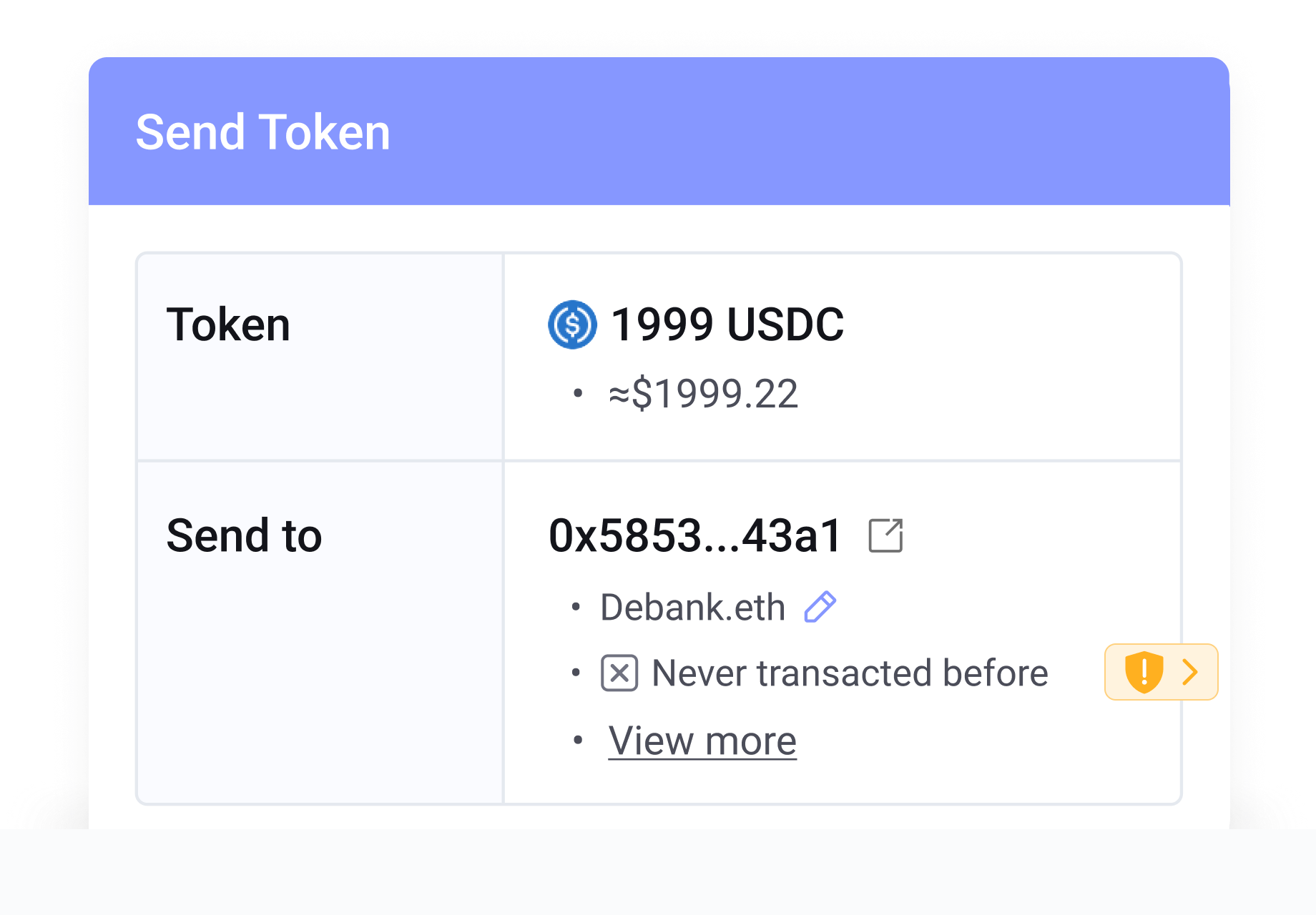
How Rabby’s transaction simulation works (mechanism first)
At its core, Rabby runs a local or RPC-backed dry run of the transaction and displays the estimated token balance deltas and the gas cost before you sign. Mechanistically, that means the wallet executes the same contract call against a node or sandbox, inspects emitted events and state changes, and converts those into a human-readable summary: which tokens will move, how much will be spent on fees, and whether a call triggers ancillary transfers or approvals. This is distinct from a simple transaction preview that only shows the calldata hex; simulation reconstructs outcomes.
Complementing simulation, Rabby runs a security engine that flags known risks: contracts associated with past hacks, suspicious approval requests (for example, blanket infinite allowances), attempts to send to non-existent recipient addresses, or calls that match exploit patterns. Because Rabby is open source and supports hardware wallets, these checks can be audited and integrated into an institutional workflow alongside multi-sig setups like Gnosis Safe or custody tools such as Fireblocks.
What simulations reliably prevent — and what they don’t
Simulation reliably prevents a subset of “blind signing” mistakes. If a malicious dApp tries to trick a user into sending all of a particular token by obfuscating calldata, the simulation will show token balance changes and make that transfer visible. Similarly, flagging infinite approvals and offering a revocation tool makes it easier to limit long-lived allowances that have historically facilitated large thefts.
But simulations have limits. They depend on the node or RPC endpoint used for the dry run: if the RPC is compromised, simulated results can be misleading. Simulations cannot predict off-chain manipulations, front-running MEV outcomes, or subtle reentrancy paths that depend on block ordering, gas refunds, or miner behavior. Moreover, simulations reflect current state — if a contract’s logic depends on external oracles that will change value by the time the transaction is mined, the simulation’s predicted balance deltas may diverge materially from the eventual result.
Practical implication: treat simulation as an advanced signal, not a guarantee. For high-value or high-complexity interactions, combine Rabby’s simulation with manual audits of calldata when feasible, hardware signing, and time-delayed multi-sig checks. Rabby’s compatibility with Ledger, Trezor, Keystone, and others makes that layered approach realistic for power users.
Side-by-side: Rabby vs. mainstream alternatives — where trade-offs land
Compare Rabby with MetaMask, Trust Wallet, and Coinbase Wallet along the security and ergonomics axes most relevant to DeFi power users:
– Security-first UX: Rabby’s simulation and risk engine are designed to reduce blind signing; MetaMask historically emphasized compatibility and ecosystem primacy, and has recently introduced transaction previews. Trust Wallet and Coinbase Wallet prioritize mobile convenience and fiat on-ramps but do not bundle the same degree of pre-transaction simulation and risk scanning.
– Operational fit for institutions: Rabby integrates with Gnosis Safe and enterprise custody solutions like Fireblocks and Amber, whereas institutional workflows often require explicit multi-sig and custody integrations that MetaMask alone can’t satisfy. If you need a multi-signer policy and on-chain spending limits, Rabby can sit in a stack with Gnosis Safe to provide the UX and simulation signal while the Safe enforces policy.
– Multi-chain convenience: Rabby supports 90+ EVM chains and automatically switches networks based on visited dApps, which reduces user mistakes when moving between Arbitrum, Optimism, Polygon, and others. This is a practical advantage for traders and arbitrageurs who work cross-chain often, but automatic switching can be a double-edged sword: a malicious site could try to lure you onto a less familiar chain. The trade-off is convenience versus the cognitive check of manual switching.
Operational rules and a simple decision framework for power users
Here are concrete heuristics you can apply immediately.
1) For routine, low-value trades: Rabby’s simulation + built-in revocation + automatic network switching give a good balance of safety and speed. Use the extension for quick DEX swaps and portfolio tracking.
2) For any trade above a threshold you define (e.g., $5,000–$50,000 depending on your risk tolerance): require hardware signing and, if possible, a multi-sig co-sign. Use Rabby’s simulation as a confirmation step, but also manually inspect approvals and calldata or route the interaction through a Gnosis Safe transaction proposal.
3) For contracts you don’t recognize: pause. Simulate, check contract source and Etherscan-like verifications, and prefer interactions with audited code. Rabby’s flags for previously hacked contracts are useful but not exhaustive.
4) For cross-chain activity: use Rabby’s cross-chain gas top-up to avoid failed transactions due to zero native gas, but consider chain-specific liquidity risks and oracle latencies that can change expected outcomes between simulation and inclusion.
Limitations and unresolved issues to watch
Rabby has clear strengths, but also boundary conditions worth tracking. It lacks a native fiat on-ramp and in-wallet staking, so users who prefer onramps or staking dashboards must pair Rabby with third-party services. The 2022 Rabby Swap exploit shows that even teams with good intentions can ship risky contract code; Rabby’s response (freeze, compensate, audit) speaks to governance and remediation capacity, but it does not erase the initial vulnerability. Open-source status helps: independent audits and community scrutiny reduce but do not eliminate systemic risk.
Another unresolved area is how wallets integrate anti-MEV defenses. Simulations do not inherently protect against sandwich attacks or front-running that unfolds between simulation and block inclusion. Some mitigation can come from RPC selection (private relay, Flashbots-integrated providers) or transaction construction (priority fees, bundled txs), but those are technical workstreams and not yet native to the typical wallet flow for most users.
What to watch next — conditional scenarios that would change the calculus
If Rabby expands direct integrations with private relay services or adds native transaction bundling that reduces exposure to public mempools, the value of simulation would increase materially for high-frequency traders. Conversely, if more exploit patterns arise that rely on off-chain state or oracle manipulation, the marginal utility of on-client simulation drops: simulations will still catch gross mismatches but not nuanced, temporally sensitive attacks.
Also look for product moves that close current gaps: an in-wallet fiat on-ramp or built-in staking would make Rabby more of a one-stop solution, but would also increase regulatory exposure in the U.S. and potentially require new KYC/AML workflows — a trade-off between convenience and decentralization/privacy that institutional users should weigh carefully.
FAQ
Does Rabby’s simulation stop all scams and hacks?
No. Simulation reduces risks tied to blind signing and obfuscated calldata by showing estimated balance changes and fees, and Rabby’s pre-transaction scanner flags known risky contracts and suspicious approvals. However, it cannot predict off-chain manipulations, MEV-based reordering once the transaction hits the mempool, or future oracle price changes between simulation and execution. Use simulation as a strong but partial control, and layer hardware wallets, multi-sig, and manual review for large exposures.
How should an institutional wallet policy incorporate Rabby?
Use Rabby as the UX layer for simulation and user-facing checks while enforcing authoritative policy in a multi-sig or custody solution (Gnosis Safe, Fireblocks). Require dual controls: Rabby’s signals inform signers, but final enforcement — time delays, spending limits, and co-sign rules — should live in the custody/multi-sig layer. Confirm that all signers use hardware devices and that RPC endpoints used for simulation are trusted.
Will Rabby replace MetaMask for power users?
Not necessarily. Rabby differentiates with simulation, approval revocation, automatic network switching, and broad hardware support, making it attractive for security-conscious users. MetaMask retains ecosystem dominance and broad dApp compatibility. Choice depends on priorities: if pre-signature transparency and institutional integrations matter more, Rabby becomes compelling; if broad consumer reach and existing integrations matter more, MetaMask may remain central. Both can coexist in many workflows — Rabby’s ‘Flip’ toggle even helps users switch between them.
Final takeaway
Rabby’s transaction simulation is an important safety innovation because it changes the unit of attention from raw calldata to concrete balance outcomes. That shift improves human decision-making. But simulation is not a panacea; it is a sophisticated signal that must be embedded in operational discipline: hardware signing, multi-sig controls, cautious approval management, trusted RPCs, and awareness of on-chain dynamics like MEV and oracle timing. For U.S.-based DeFi power users, Rabby is a useful tool in a layered defense strategy — particularly when combined with institutional custody or multisig — but it should be adopted with clear rules about when simulation alone is sufficient and when stronger controls are required.
For readers interested in installing and experimenting with the browser extension discussed in this article, see the official rabby wallet extension.